

The Manager and the Machine
Imagine a human manager — confident, leaning back in his chair, certain that his job is safe.
At the same time a sophisticated machine looking quietly across the table, thinking: I’m already doing his job.
That single image captures the entire debate around AI.
Will it replace the routine, less cognitive work?
Will it replace the strategic, executive work? Or — perhaps the most interesting possibility — can humans and machines partner in ways that make both more effective than either could be alone?
The honest answer depends on what AI actually is, and what makes it different from every technology that came before it. So let’s start there.
What AI Actually Is — and Why It's Different
At its core, AI refers to a set of algorithms designed to perform tasks that typically require human intelligence — from recognising speech to making decisions. It splits into two broad camps:
Machine Learning (ML): Algorithms that learn from data to make predictions.
Deep Learning (DL): A subset of ML that uses neural networks — architectures loosely modelled on the human brain — to find patterns in unstructured data.
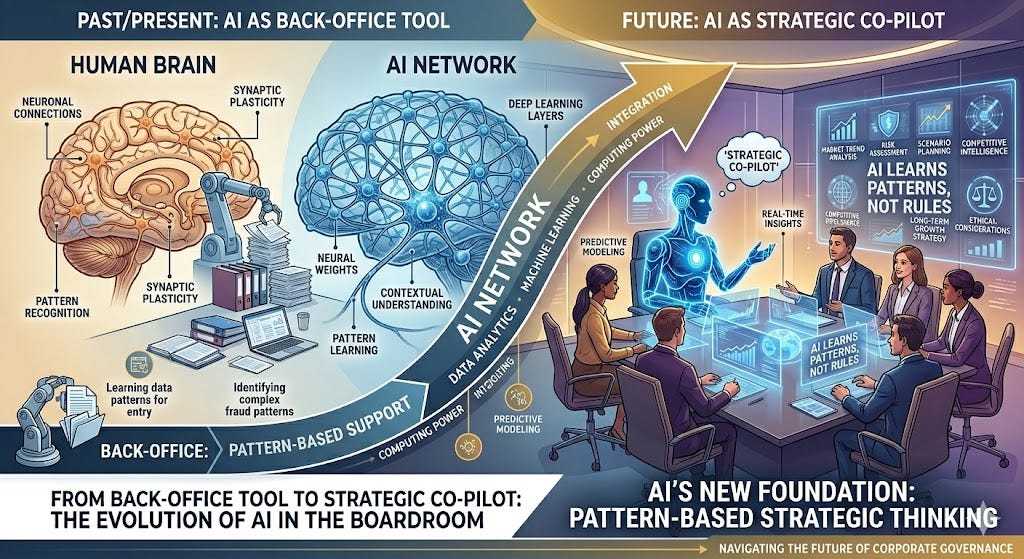
But to understand why today’s AI feels qualitatively different from anything before it, you have to understand what came before: expert systems.
Early AI, dating back to the General Problem Solver developed by computer science pioneers Herbert Simon, Cliff Shaw, and Alan Newell, was built on a simple premise: human decision-making could be encoded as a series of if-then rules. Expert systems didn’t learn. They executed. They worked beautifully for problems that could be fully formalised — chess being the canonical example — and broke down for problems that couldn’t.
Try this for a moment: think about every decision you’ve made today. How many of them could you actually write out as if-then statements? That gap is exactly where expert systems hit their ceiling. And it’s where modern AI begins.
Modern AI doesn’t rely on if-then logic. It learns from data, recognises patterns, and — at its best — develops something that looks remarkably like intuition. This isn’t marketing language; it’s a fundamental architectural shift. And nowhere is that shift more visible than in a tale of two famous matches.
Deep Blue vs. AlphaGo: From Brute Force to Intuition
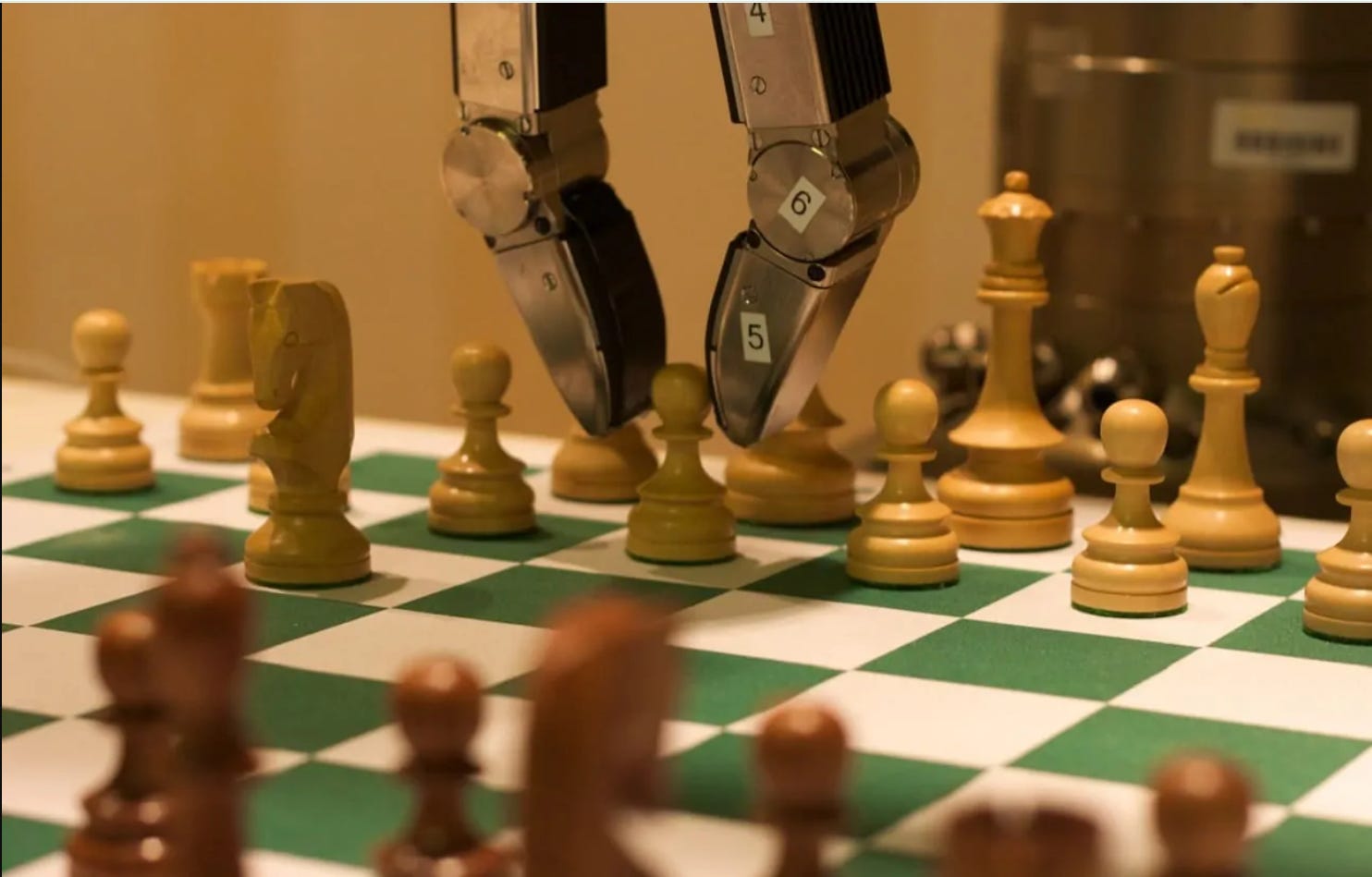
In 1997, IBM’s Deep Blue defeated reigning world chess champion Garry Kasparov. It was a milestone — but a misleading one. Deep Blue wasn’t intelligent; it was fast. It evaluated 200 million possible moves per second, searching roughly 50 billion positions in the three minutes typically allotted for a single move. It won by sheer computational muscle. A year earlier Kasparov had beaten an earlier version through strategy — the very thing Deep Blue could not actually do.
Fast-forward to 2016. DeepMind’s AlphaGo took on Go champion Lee Sedol — a game with so many possible positions that brute-force search is mathematically impossible. AlphaGo didn’t out-calculate Sedol. It out-thought him.
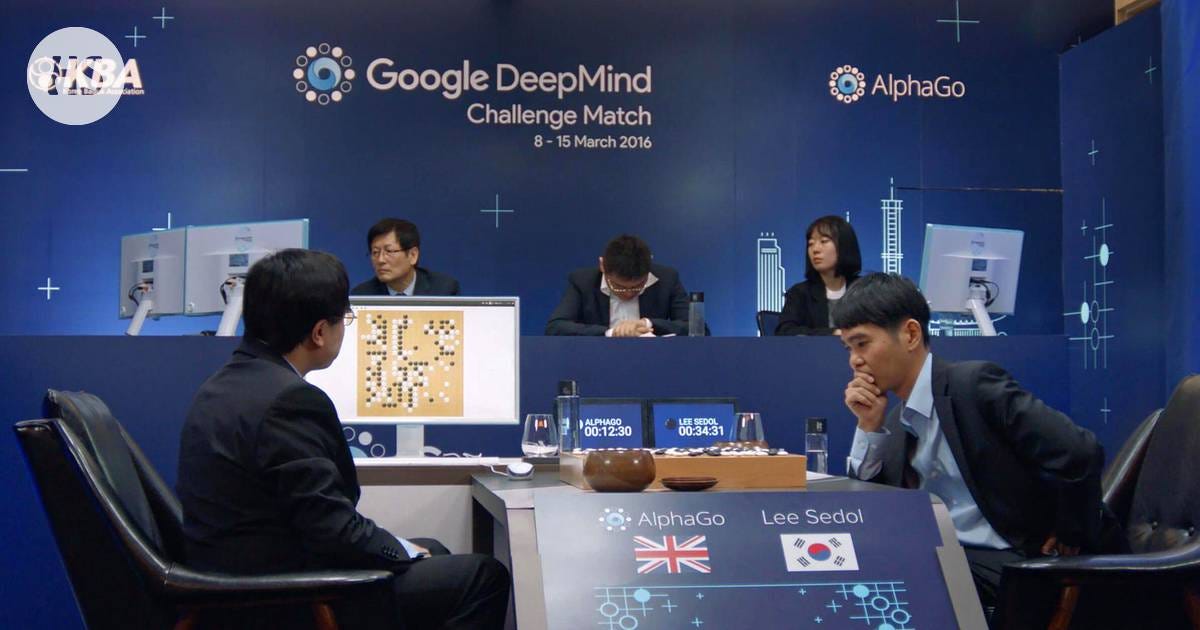
Then came the moment that has since become legendary in AI circles: move 37 of game two. Commentators initially called the move bizarre. Some thought it was a mistake. It was neither. AlphaGo had traded a short-term loss for a long-term gain — exactly the kind of strategic sacrifice human grandmasters make. Sedol later admitted he could no longer tell whether he was playing a machine or a person.
This is the shift that matters: from algorithms that calculate to algorithms that learn and strategise. Deep Blue was an end. AlphaGo was a beginning.
Why Now? The Perfect Storm Powering AI’s Rise
If neural networks have been around for decades, why is AI suddenly everywhere?
Three forces have converged at the same moment:
Compute has gotten cheap. AlphaGo ran on 1,920 CPUs and 280 GPUs — an unthinkable setup a decade earlier, almost routine today.
Data has gotten abundant. Modern AI is hungry for data, and the digitisation of nearly everything has finally fed it.
Investment has poured in. Private AI investment hit record levels in 2021 and has continued at extraordinary scale. Venture capital, private equity, and big tech are racing to fund the next breakthrough.
The result: benchmarks that once seemed years away are falling faster than researchers predicted. In image classification, AI surpassed human accuracy around 2015 and has kept climbing. Facial recognition, pose estimation, visual question answering, language understanding — every benchmark tells the same story of relentless progress.
What was once the exclusive domain of well-funded labs is now within reach of startups, mid-sized firms, and even individuals. Prediction has been democratised.
The Electricity Parallel: AI as a General Purpose Technology
Here’s the most important framing in this entire piece: AI is not a tool. It is a General Purpose Technology (GPT).
Electricity didn't just light bulbs — it rewired the economy. AI is on a similar arc.
General Purpose Technologies are rare. They share three defining traits:
They permeate multiple sectors, becoming building blocks for products and services across the economy.
They improve continuously, unlocking new capabilities long after they first appear.
They spawn complementary innovations, creating entirely new industries that didn’t exist before.
The canonical example is electricity. In the 19th century, electricity wasn’t just about light bulbs. It rewired factories, reshaped cities, enabled mass communication, and gave birth to entire industries — broadcasting, refrigeration, modern manufacturing. The economic gains came not from electricity itself but from everything that became possible because of it.
AI is on a similar trajectory. It is boosting productivity without requiring proportionally more capital or labour. Sparking innovation across healthcare, finance, manufacturing, and entertainment. Enlarging the pie rather than redistributing it.
This is why “AI strategy” can’t be a side project or an innovation-lab experiment. It is the new operating layer of the economy.
Every Quadrant of Work — Touched by AI
For decades, automation was confined to one corner of work: routine, manual tasks like assembly lines and repetitive data entry. AI changes the map entirely. Plot work on two axes — routine vs. non-routine, manual vs. cognitive — and AI is now active in all four quadrants:
Automation used to mean one quadrant. AI is active in all four.
Routine manual: The original automation territory, now extended further by AI-guided robotics.
Routine cognitive: Customer service chatbots, fraud detection, claims processing, financial analysis — AI is transforming the back office.
Non-routine manual: Robots assisting in surgery, harvesting delicate fruit, even preparing meals.
Non-routine cognitive: Where the impact is most profound. AI now augments engineers, doctors, designers, and researchers — helping generate ideas, analyse complex data, even create art.
The implication for leaders is significant. AI isn’t confined to a corner of the org chart. It’s a horizontal capability that touches every function — which means every function leader now has an AI question to answer.
The Survival Math
Three numbers from recent executive surveys deserve a place on every leadership team’s wall:
75% of executives believe their company risks going out of business if they don’t scale AI.
84% believe they won’t achieve their growth objectives without scaling AI.
A roughly equal share say they currently struggle to scale AI.
Read those numbers together. They describe a crisis — of awareness, of capability, and potentially of survival. The longer companies wait, the further behind they fall, and the harder it becomes to catch up. The domino effect is real: your suppliers are using AI to optimise their operations; your competitors are launching AI-powered products; your customers are quietly raising their expectations.
In short, AI isn’t a luxury anymore. It’s table stakes.
From Automation to Augmentation
The real opportunity isn’t replacement. It’s partnership.
Here’s the reframe that matters most. The story of AI in business is not primarily a story of replacement. It’s a story of augmentation — humans and machines combining to do what neither could alone.
Yes, some routine roles will be displaced. New roles will also emerge. But the deeper opportunity lies in the partnership: human judgment, ethics, and creativity coupled with AI’s computational power and pattern recognition. Managers who learn to act as catalysts — orchestrating that partnership rather than competing with it — will deliver results that were previously unimaginable.
The cartoon at the start showed a manager and a machine eyeing each other warily across a table. The future belongs to leaders who put them on the same side of it.
The Bottom Line
AI is everywhere. AI is a GPT. The risk of not adopting is high — and rising. In the short term, even basic AI implementation can deliver a competitive edge. In the long term, deep integration into your processes, products, and strategy is where lasting advantage will lie.
The question is no longer whether your organisation should adopt AI. It’s how quickly you can — and how thoughtfully you’ll do it. The future of business belongs to leaders who treat AI not as a threat to be managed, but as a force multiplier to be mastered.
The revolution isn’t waiting.